
Misinformation Masterclass
A Wall Street Journal editor packs a pandemic’s worth of confusion into just 102 words

The Wall Street Journal just added a perfect capstone to its record as a reliable source of unreliable information on COVID. The examples began within a month of the first US death, when it gave Stanford economist Jay Bhattacharya a platform to suggest that COVID might kill as few as 20,000 to 40,000 Americans. In 2021, Johns Hopkins gastrointestinal surgeon Marty Makary used two separate op-eds to insist that the country was on the verge of herd immunity and a return to normal. More than seven hundred thousand Americans have died of COVID since the first of these was published.
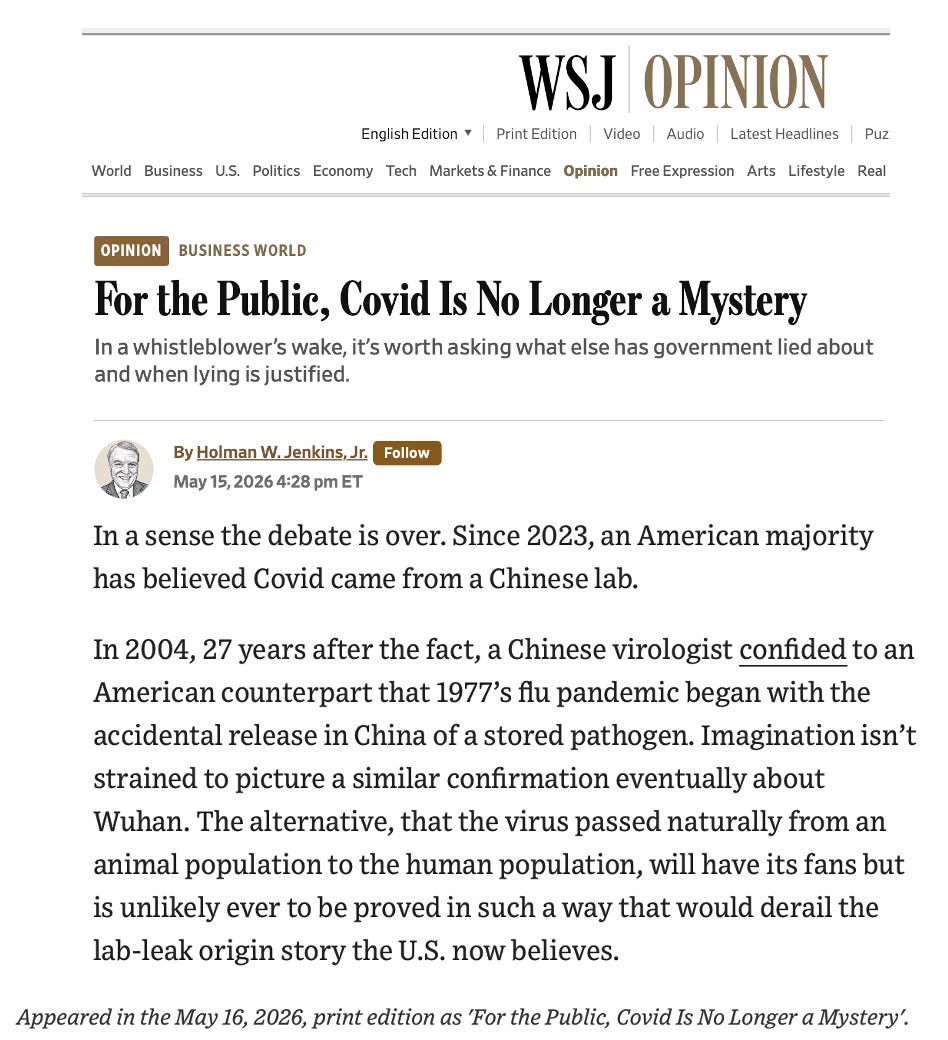
The list goes on. Public health interventions, from masks to vaccines, were dismissed as unnecessary, even dangerous overreach. Then, on May 16, the opinion page outdid itself. Editor Holman Jenkins distilled the essence of scientific misinformation and how it spreads into a mere five sentences, less than two full tweets. Let’s break it down.
“In a sense the debate is over. Since 2023, an American majority has believed Covid came from a Chinese lab.”
The hedge is doing heavy lifting. The “sense” in which truth has apparently been definitively determined turns out to be public opinion. But the origin of the SARS-CoV-2 virus is fundamentally a scientific question. Science is not a democratic process. It is a relentless search for the truth as incrementally revealed by the slow accumulation of scientific evidence. The polls reflect the success of a misinformation campaign, not truth.
Even debate is not a standard tool of science. Those calling for debate tend to be influencers, politicians, and even quarterbacks, who want rhetorical flourishes, gotchas, and spectacle.

What the polls obscure is how implausible the dominant story becomes once you do the arithmetic. Creating the virus from its closest known relative would require ten times the number of genetic changes generated over the course of a three year long global pandemic with billions of human infections. The ability to do that exists only in science fiction. The alternative would require a cover up so vast that it boggles the mind and defies probability. I have laid out both the implausibility of creating the virus and the improbability of its secretive release in previous posts.
“In 2004, 27 years after the fact, a Chinese virologist confided to an American counterpart that 1977’s flu pandemic began with the accidental release in China of a stored pathogen.”
The 1977 analogy is bad on its own terms. The pathogen in the 1977 release was a flu virus frozen in the 1950’s. Other lab leaks have occurred, but their epidemiological patterns differ dramatically from COVID and they have never involved novel pathogens. As I have described in a previous post, both the epidemiology and the virology of the beginnings of the COVID pandemic reveals patterns that differ dramatically from known lab leaks.
“Imagination isn’t strained to picture a similar confirmation eventually about Wuhan.”
Imagination is not evidence. The fact that one can picture something is not a probability claim. Unfortunately, the ways in which information has been released has encouraged the use of imagination and speculation in determining the origins of COVID.
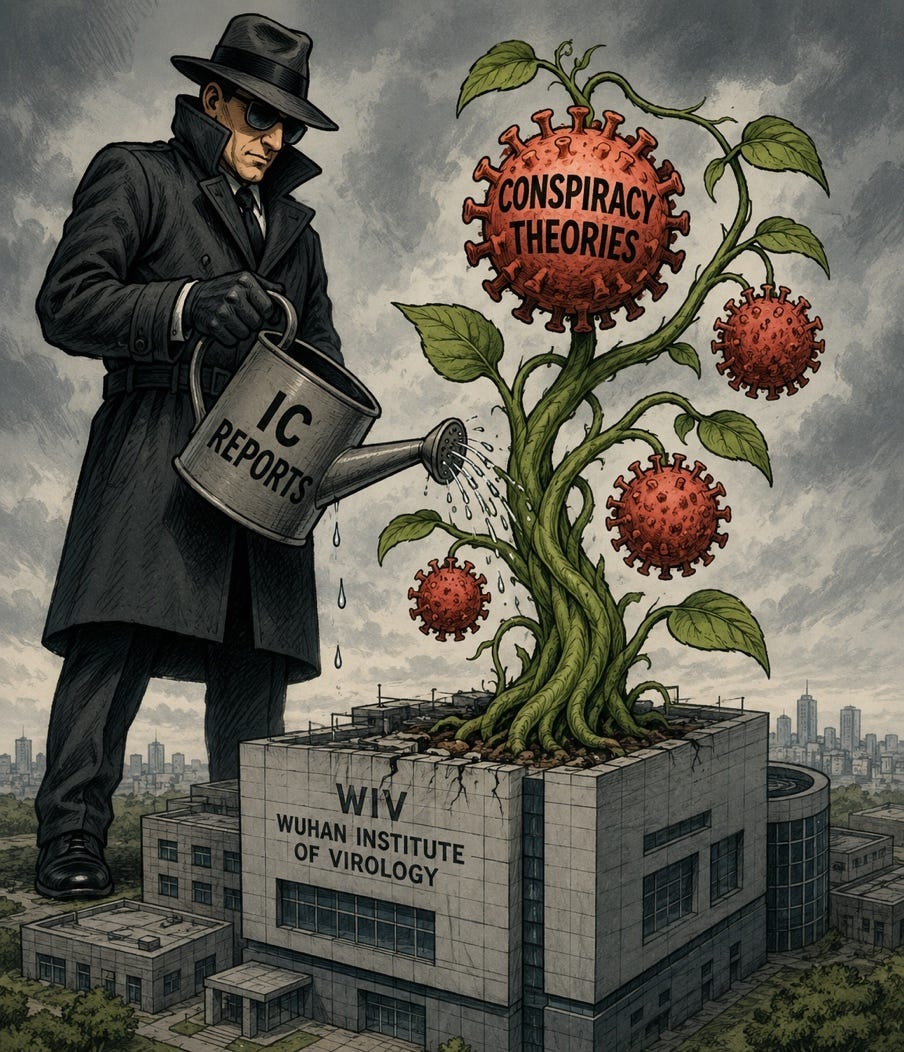
In particular, the Intelligence Community Assessments are perfectly structured to manufacture the appearance of secret confirmation while disclosing almost nothing: undefined confidence levels, unnamed agencies, undisclosed experts, and unspecified evidence, all wrapped in the institutional credibility of “intelligence.” The shifts at DOE and CIA were widely received as new classified information emerging, when in fact no new intelligence was involved in either case. I have written about how that machinery works here. That is the foundation for Jenkins’s “imagination”.
“The alternative, that the virus passed naturally from an animal population to the human population, will have its fans but is unlikely ever to be proved in such a way that would derail the lab-leak origin story the U.S. now believes.”
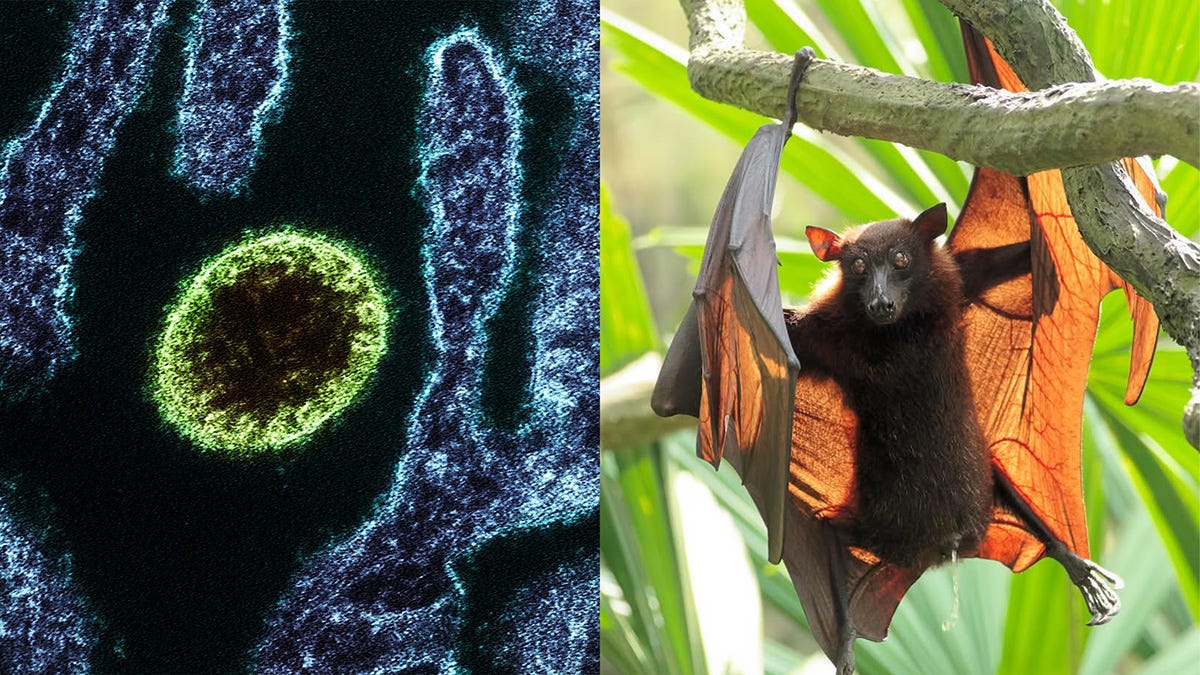
There are no “fans” of zoonotic origin. Every novel human pathogen on record, without exception, has emerged from animals. That is the base rate Jenkins needs to overcome, and he does not even acknowledge it. The full historical record is here. Calling zoonotic origin a fan position is the rhetorical inversion at the core of the entire genre: it treats the null hypothesis, the explanation that fits every prior novel human pathogen, as the partisan view, and treats the speculative alternative as the default. That inversion is the whole trick. Jenkins has executed it in five sentences. It deserves to be named.
And, if we step back from this misinformation haiku to consider its provenance and placement, we get the full picture of how misinformation spreads. Its tweet-like brevity echoes the reference-free simplicity of social media. Its author’s lack of scientific training captures the modern-day disregard for expertise. And the cavalier use of the WSJ’s reach and authority has defined the conservative media’s approach to science in general and COVID in particular.
The game is over. Misinformation is doing its victory dance.
WSJ is perhaps the most pernicious source out there. Under the guise of sober, unruffled analysis, often accompanied by a nauseating condescension, the Journal normalizes everything from Trump's behavior to this dangerous misinformation. It depresses me that "moderates" read this stuff and figure it's reasonable. It's not.
"Those calling for debate tend to be influencers, politicians, and even quarterbacks, who want rhetorical flourishes, gotchas, and spectacle."
The primary reason live debates aren't a part of science is that they don't test the veracity of competing claims, they only test the rhetorical skills of the debaters